AI stock sell-off spreads from Korea chips to SpaceX
AI stock sell-off pressure spread from South Korean chip names into SpaceX and U.S. futures, turning a local pullback into a global reset.
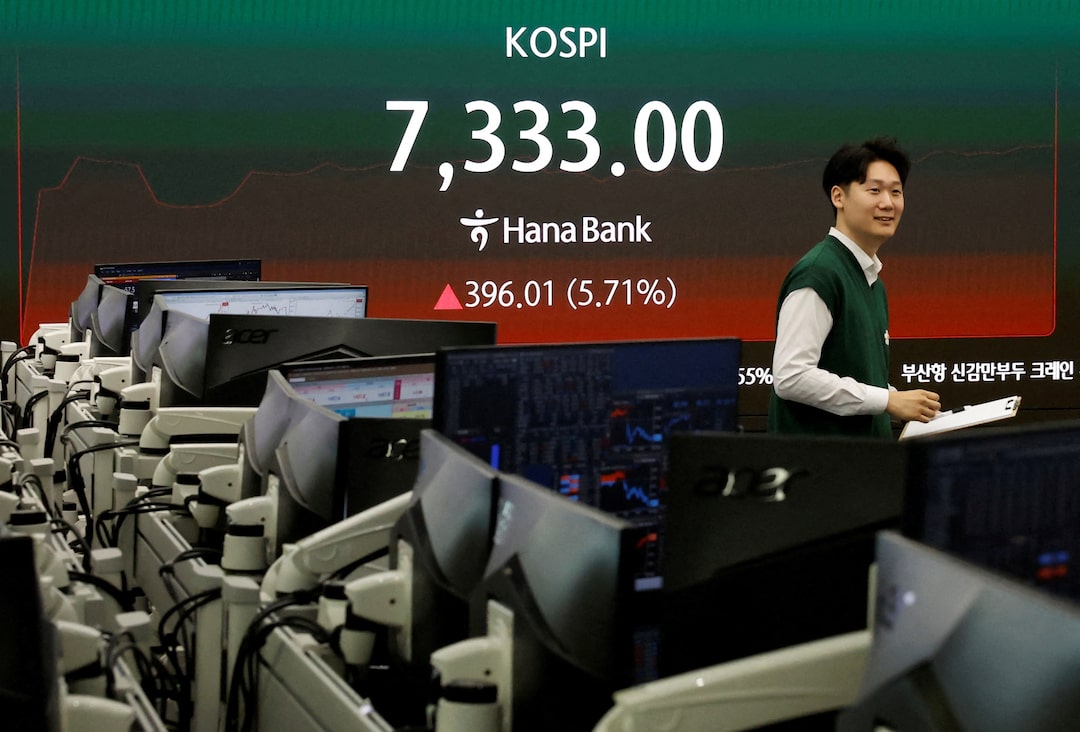
A sell-off in South Korean chip names spilled through Europe and into U.S. futures on Tuesday, deepening a retreat in high-valuation AI trades and turning SpaceX into the market’s newest stress signal. According to the research brief assembled for this story, the Kospi was down 10 per cent from its recent record high, while S&P 500 futures were 1.3 per cent lower before the opening bell. Seen together, those moves shift the story away from one weak session in New York and toward something broader: investors are beginning to reprice the cost of owning the AI trade across markets that had all been rewarded for the same theme.
Traders had spent months explaining away each wobble in tech as local noise: a crowded trade here, an earnings disappointment there, a brief rotation into defensives. Yet that defence becomes harder to hold when the selling starts in a chip-heavy Asian market, passes through Europe and then lands on U.S. futures and a newly public name that had been treated as a scarcity asset. Across regions, the AI trade’s unwind no longer looks confined to one stock or one exchange. Tuesday therefore felt less like a routine Nasdaq stumble and more like the start of a cross-border valuation reset.
At stake is the difference between a correction and a derating. Corrections are usually position clean-outs after a fast run higher, painful but contained. Deratings are harsher. Under a derating, investors are no longer arguing about which company deserves the highest premium inside a theme; they are arguing about whether the theme as a whole deserves the same premium at all. Tuesday’s tape pointed toward that second debate. Seoul was the early warning, SpaceX was the live test, and U.S. futures said the read-through was not staying in Asia.
All of that is why this is not just another stocks roundup. Put simply, South Korea’s sell-off mattered because it hit a market that had been carrying a clear AI and semiconductor identity. When a benchmark built around that optimism gives back 10 per cent from a record high, investors have to ask whether the premium attached to AI exposure was too generous, too global and too dependent on the assumption that every part of the chain could keep compounding without a pause.
Why Seoul mattered
Seoul had become one of the clearest offshore expressions of AI enthusiasm because its equity story was tied closely to Samsung Electronics and SK Hynix, the two chip heavyweights named in the brief for this story. In that setting, investors cannot dismiss the move as a narrow U.S. growth scare or a problem confined to one options-heavy corner of Wall Street. More importantly, the market’s message becomes harder to ignore when the first serious crack appears in a benchmark that had also been rewarded for AI-linked exposure.

Measured against recent gains, a 10 per cent drawdown from a record high is too deep for the market’s usual vocabulary of a healthy pause. That scale suggests the move is not simply about traders lightening up after strong gains. It signals a challenge to the multiple investors were willing to pay for a market that had become a liquid proxy for semiconductor optimism. Once a non-U.S. market that had been rewarded for its chip leverage starts breaking lower, the trade stops looking like a domestic U.S. rotation and starts looking like a global rethink.
Overnight sequencing mattered too. Rather than waiting for New York to decide whether tech had become overextended, global investors were handed an early verdict from a market that had also been financed by AI enthusiasm. By the time Europe carried the tone forward and U.S. futures followed, the question had widened. No longer was the issue whether American platform stocks had run too hard. The issue was whether the broader chain of beneficiaries, from chip names to high-premium listings, had all become too expensive at the same time.
Why SpaceX became the stress signal
SpaceX matters for a second reason. Because the company had already been cast, in the reporting and in the brief, as a post-IPO valuation bellwether, its weakness landed differently from the weakness in an established megacap. Fresh listings do not get the same mercy as mature cash generators or buyback stories. Belief does much of the work for them. Once investors stop assuming they will keep paying up for future growth, the damage tends to show faster and more cleanly.

Read that way, SpaceX’s slide looks larger than a single-company problem. Scarcity was part of the appeal. Narrative power mattered too. When such an asset starts falling in step with chip proxies in South Korea and weakness in U.S. futures, the market is sending a clear message: even prized stories must now answer to price. Investors are reducing exposure not only to yesterday’s AI winners, but also to the names that had been granted the most benefit of the doubt about tomorrow.
Psychology matters as well. New issues often work as sentiment accelerants: they rise quickly when confidence is plentiful, and they give way quickly when the market decides the premium was stretched. Buyers watch them not only for company-specific clues but for evidence about the mood of the tape itself. Under that lens, SpaceX’s post-IPO weakness functions as a referendum on whether the AI complex can still command heroic valuations in a market that is starting to demand proof, patience and lower entry points.
Correction or broader derating?
From here, the question is whether this remains a correction inside a still-intact uptrend or becomes the start of a broader derating across tech-heavy markets. Breadth comes first. Should weakness stay concentrated in the highest-multiple chip and AI proxies, the episode can still be framed as an overdue clean-out of the most crowded names. If pressure keeps radiating from South Korea into Europe, U.S. futures and fresh listings, the case for a wider reset grows stronger. Cross-market transmission is the signal to watch. So is the quality of the rebound, if one comes.
Another test is who steps in to buy. During shallow corrections, long-only funds and systematic buyers often treat sharp selling as a chance to rebuild positions at better prices. In a deeper derating, that reflex changes. Buyers wait longer. They demand more evidence. Good stories still attract interest, but ambitious multiples no longer do the heavy lifting on their own. Tuesday’s tone, as described across NBC News, The New York Times and CNBC, looked closer to that second mood than to a routine one-day wobble.
Nor does any of this guarantee a straight line lower. Valuation resets can stabilise as quickly as they erupt, especially when the underlying growth narrative remains intact. Still, the market threshold has changed. Once Seoul’s chip-heavy market, a newly public bellwether such as SpaceX and U.S. futures are all sending the same signal, investors can no longer describe the move as an isolated patch of volatility. From here on, the centre of gravity shifts from earnings arithmetic to valuation discipline. The question is no longer only which company can produce the next eye-catching growth number. It is which names can still justify premium pricing after the market has started to withdraw the benefit of the doubt from the whole AI chain.
For scramnews readers, that is the important reset. Seoul delivered the first loud answer, not because it told investors anything mystical about technology, but because it exposed how far the same trade had spread. SpaceX ensured Wall Street could not ignore it. If buyers want to reclaim control of the narrative, they will need to do more than defend a few marquee names on the next bounce. They will need to show that the AI trade still deserves a global premium, from chip-heavy Asia to the newest listings in the U.S. Until then, every rebound will have to clear a higher bar.
Sloane Carrington
Markets columnist. Analytical pieces and deep-dives on monetary policy, capital flows and corporate strategy. Reports from New York.