Korean stocks tumble 9% as chip rout forces second halt
South Korean stocks slid as much as 9%, forcing another 20-minute halt as Samsung and SK Hynix sank and AI-chip nerves spread across Asia.
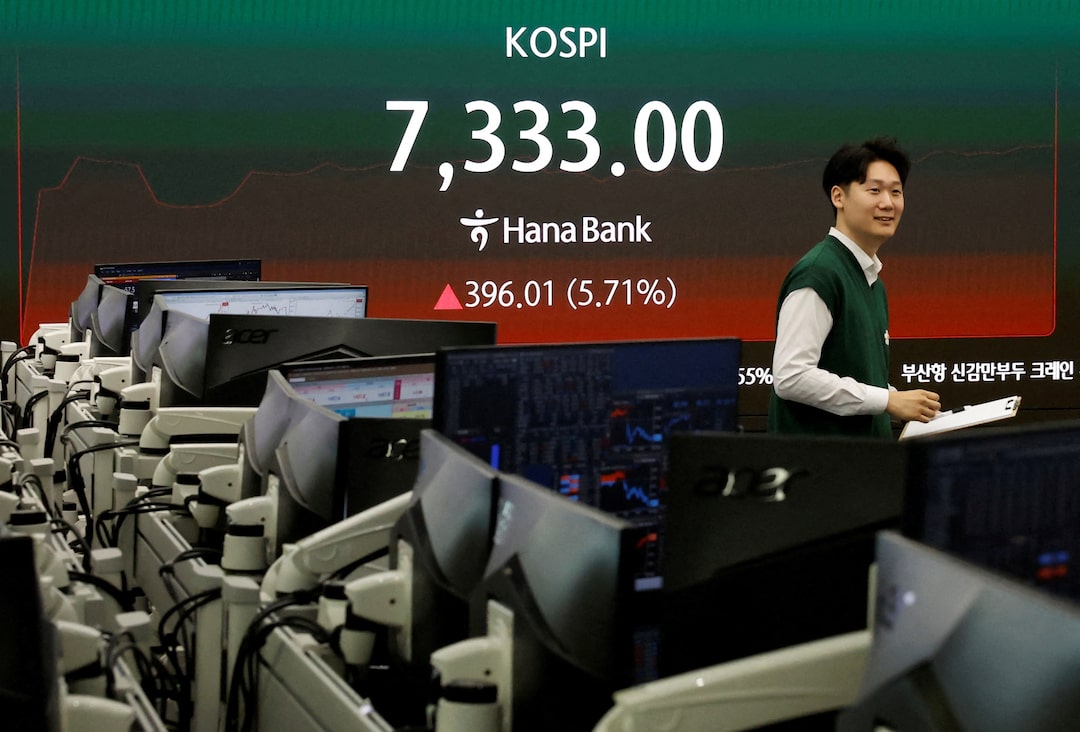
South Korean stocks fell as much as 9 per cent on Friday, triggering a second trading halt this week as Samsung Electronics Co. and SK Hynix Inc. led a semiconductor selloff that dragged the wider Kospi lower.
The Korea Exchange’s 20-minute pause made the shift hard to miss. South Korea’s benchmark is still a gauge of exports and domestic growth, but Friday’s trading looked more like a stress test of the global AI trade. Weakness in a small group of memory-chip names was enough to set off a market-wide brake.
The pressure remained after trading restarted. Reuters reported the Kospi was last down 5.8 per cent as Asian shares retreated, with technology valuations and Apple’s latest price increases weighing on risk appetite. Bloomberg’s later account said the benchmark had been down as much as 9 per cent at the low.
Foreign investors were part of the move, not just bystanders. Bloomberg said overseas funds sold more than 5 trillion won, or about $3.2 billion, of Kospi shares, adding to the loop between chip stocks, index futures and forced de-risking. The halt was South Korea’s fifth circuit-breaker activation this year, according to Bloomberg. For a market that had pulled in money on AI-driven memory demand, that is a sharp change in tone.
The sequence also cut against the idea of a brief opening imbalance. Circuit breakers are designed to cool disorderly trading, yet Bloomberg and Reuters both showed selling continuing after the pause. Investors were still reducing exposure to the same stocks that had served as the region’s shorthand for AI upside.
Bloomberg quoted Homin Lee as tying the selloff to two catalysts hitting that crowded trade at once:
“rumors of IPO delays in the US, alongside Apple’s price hikes”
Homin Lee, Bloomberg
Why chips mattered
Samsung and SK Hynix sit near the centre of the Kospi’s global AI story. To many overseas investors, they are among the cleanest listed routes into memory pricing, server demand and hyperscaler spending. When both fall together, the benchmark has little room to absorb the shock elsewhere.
That is why Friday’s decline travelled beyond Seoul. A benchmark that has halted twice in one week is signalling that the AI trade is starting to behave less like a straightforward growth theme and more like a source of index-level fragility. Charu Chanana, in comments carried by Bloomberg, said investors were starting to price that shift:
“The risk is that a stronger memory cycle today starts to slow the broader AI trade tomorrow. And the market is starting to price that risk.”
Charu Chanana, Bloomberg
Reuters placed the move inside a wider Asian retreat. Seoul still looked unusually exposed. Few major regional benchmarks are as tightly tied to the memory cycle, leaving the Kospi vulnerable when doubts over AI spending, IPO demand or consumer hardware pricing arrive together.
The next markers are plain enough: whether foreign selling extends, whether Samsung and SK Hynix stabilise after Friday’s reset, and whether US technology sentiment calms. If those signals stay weak, South Korea’s latest halt may look less like a local jolt than an early sign that AI-linked chip concentration is starting to strain equity markets across Asia.
Avery Lin
Markets editor covering US equities, single-name stocks and quarterly earnings. Reports from New York.