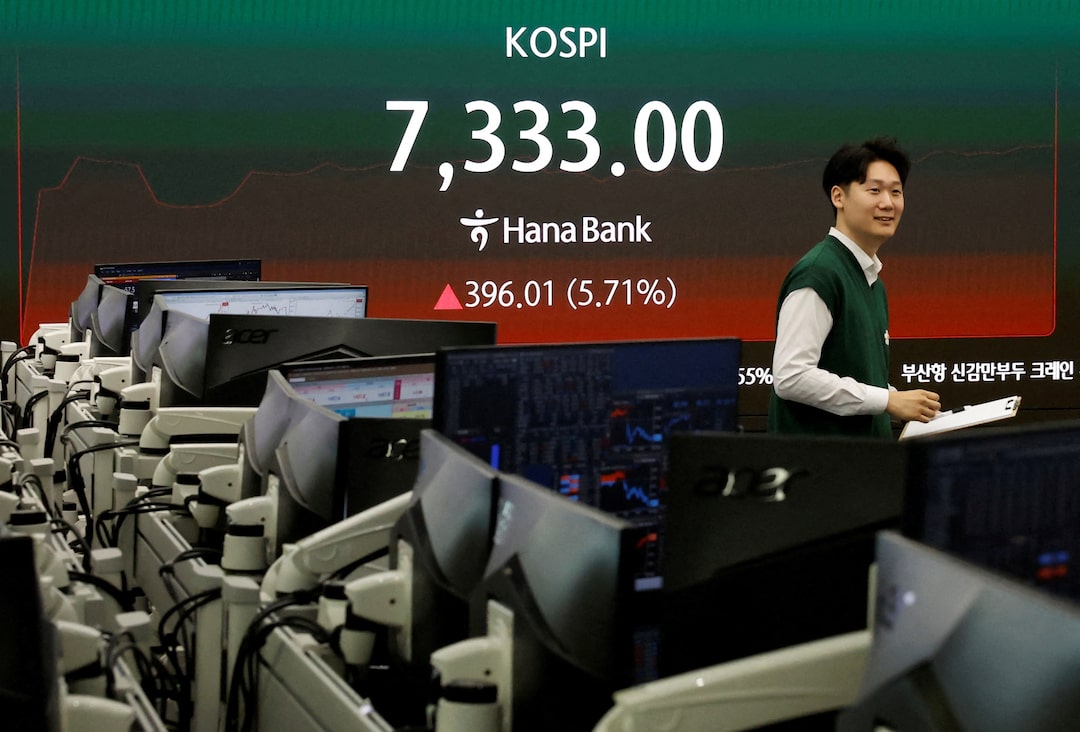
South Korea stocks tumble 6% as AI jitters hit chipmakers
South Korea stocks tumbled more than 6% after Meta's compute-resale plan fuelled AI overcapacity fears, dragging Samsung and SK Hynix lower.

South Korean stocks fell more than 6 per cent early Thursday before paring the loss, with Samsung Electronics and SK Hynix hit after Meta Platforms (META) outlined plans to sell computing power. The plan revived a harder question for the artificial-intelligence trade: whether the buildout is moving from shortage toward spare capacity. The KOSPI was about 4 per cent lower by 12:25 p.m. in Seoul, after an earlier 6.25 per cent slide. Samsung dropped 7.71 per cent and SK Hynix lost 9.34 per cent.
Seoul is an exposed place for that question to land. The benchmark leans heavily on memory and semiconductor shares. A fresh doubt about US buyers’ demand for AI compute can therefore move the index faster than it would in broader regional markets. The link was immediate.
Union Bancaire Privee managing director Vey-Sern Ling told Bloomberg that Meta’s willingness to market “excess compute” suggested the company might be struggling to find enough work for the capacity it had built, or that it had built too much. His remark turned a corporate plan into a broader utilisation worry.
“Meta considering selling its ‘excess compute’ suggests it may be struggling to find a good use for it or may have overbuilt.”
Vey-Sern Ling, Union Bancaire Privee, cited by Bloomberg
CNBC reported that the chip rout spread from Wall Street into Asian trading. The damage was narrower than a generic Korea selloff: not banks, not autos, not defensives, but the stocks most tied to the assumption that AI infrastructure demand would keep expanding.
Why the chipmakers led
Samsung and SK Hynix sit near the centre of that trade because both companies supply memory used in AI servers. Once investors question whether hyperscalers are still short of capacity, those suppliers tend to be marked down first. The size of the early declines showed how quickly traders moved from debating AI scarcity to pricing the risk of an overbuild.
Analysts quoted in the reports stopped short of calling the session a verdict on the whole sector. The sharper read was a fast unwind in crowded AI positions, particularly in a market where retail participation can magnify a break in momentum. Gerald Gan, cited by Bloomberg, said Korea may still be clearing speculative retail positions funded with borrowed money.
That distinction matters. If Thursday’s fall was partly position-clearing rather than a clean read on chip demand, it says as much about how extended Korea’s AI-linked rally had become as it does about Meta’s compute plan. The market route was plain enough, though: a US AI-capex signal hit the semiconductor supply chain first, and South Korea absorbed the shock almost at once.
The next test is whether selling reaches other AI hardware names and whether large buyers give firmer guidance on the capacity they still need. For now, the slump left a more uncomfortable question than a routine profit-taking dip would have done. If the buildout is no longer defined only by shortage, investors have to decide which part of the AI equity story gets repriced next.
Avery Lin
Markets editor covering US equities, single-name stocks and quarterly earnings. Reports from New York.