Japan's super-long JGB market loses a natural buyer
Japan super-long JGB yields are climbing as life insurers turn sellers, weakening a key source of duration demand in a market global investors watch.
Japanese life insurers became net sellers of super-long domestic government bonds in May, offloading ¥201.2 billion of debt due beyond 10 years after they had bought ¥327.2 billion in April. For a market used to treating the life sector as a quiet anchor at the far end, the reversal is uncomfortable. Selling into a yield spike is more than a mark-to-market event. It says the balance-sheet logic around long duration is changing.
The far end of Japan’s curve has long relied on domestic holders whose liabilities run years into the future. Their presence never made the market risk-free, but it made the JGB market look steadier than many sovereign markets with similar debt burdens.
Once that buyer base becomes more price-sensitive, the super-long sector stops looking like a protected compartment of the state and starts behaving more like a market.
Rates strategists read the same flow data less as a monthly curiosity than as a warning about market structure. Inside the life sector, higher yields can justify moving away from low-return domestic duration. For the market, the same decision removes a stabiliser from the 20- to 40-year sector just as volatility is rising.
One month of selling does not define a trend. The problem is that the long end now has to clear at higher yields without assuming insurers will automatically step in.
The overseas read-through is direct. Domestic yields in Japan influence hedging costs, currency decisions and the relative appeal of overseas fixed income for some of the world’s biggest institutional pools. The Bank of Japan raised its policy rate to 1 per cent on June 16, the highest since 1995, while Japan’s core inflation held steady in May. Those facts make May’s insurer selling look more consequential than a routine monthly position change.
Why insurers changed sides
Reuters’ earlier reporting suggests the May numbers fit a broader pattern rather than a one-off wobble. In October, Reuters said 10 domestic life insurers with nearly ¥300 trillion of assets under management planned to centre their yen bond activity on portfolio rebalancing and allow overall holdings to shrink. Seen that way, the May sales are a visible point on a slower adjustment. If yields rise far enough to change asset-allocation maths, insurers do not have to behave like public utilities for the bond market.
April and May tell the story neatly, maybe too neatly. April, the first month of Japan’s fiscal year, brought buying. May brought selling as super-long yields climbed.
Conditional demand is the point. A market can tolerate it for a while, but the adjustment gets harder when the swing buyer is a sector whose liabilities already run decades into the future and whose investment committees are being offered better nominal returns elsewhere.
Reuters also hinted that insurers were not simply choosing between owning more or fewer super-long JGBs. They were rebalancing across a wider opportunity set as yields moved. If domestic credit, shorter-dated paper or carefully hedged overseas assets offer a better risk-adjusted return, the far end of the JGB curve has to compete for capital rather than receive it by habit. In practical terms, insurers are still buyers of duration, but only at prices that work harder for them.
Why policy tweaks may not be enough
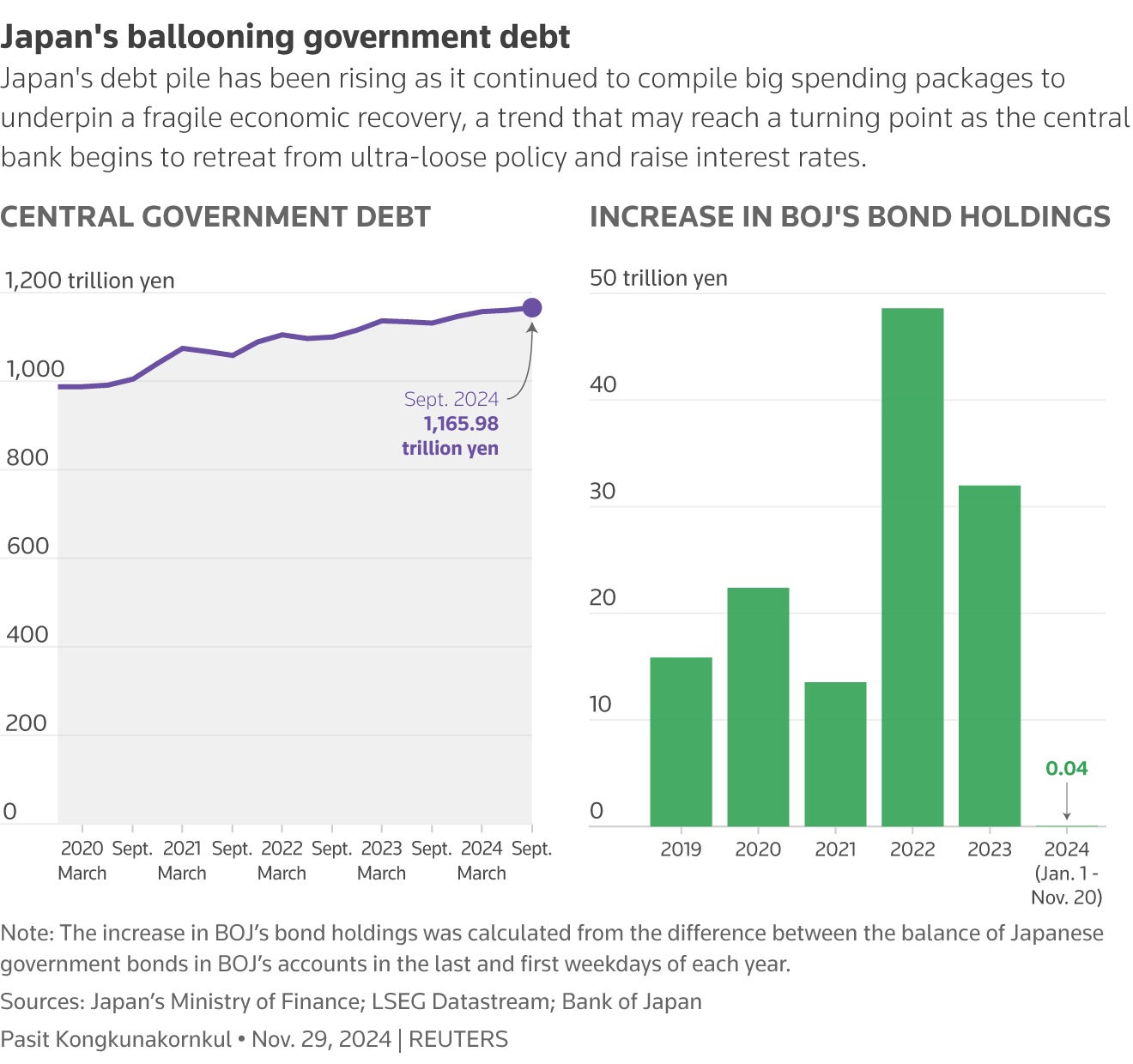
Tokyo has already floated a partial answer. Reuters reported in May that Japan would consider trimming issuance of super-long bonds while leaving the overall size of debt issuance unchanged. The idea is a sensible market-functioning response. It reduces near-term pressure on the longest maturities without forcing the Ministry of Finance to signal a broader fiscal retreat. It also tells rates strategists that officials can see the same thinness in demand that the market is trying to price.

Supply management can buy time, not demand. The Ministry of Finance can alter auction composition. The Bank of Japan can shape the front end and the inflation debate. Neither institution can easily recreate the structural demand that once made the super-long sector easier to finance.
If insurers are selling because yields have changed the return calculus, a supply tweak may smooth the calendar, but it does not restore the old buyer base. Trimming supply can stabilise trading conditions; on its own, it does not solve the deeper repricing problem.
Bloomberg warned in May that Japanese equities were coming under pressure as long-term rates approached 3 per cent. The point was not that stocks and bonds move together every session. Japan’s long-term yield level had started to matter again for asset valuations, borrowing costs and confidence in the policy mix. If that is true for equities, it is even more true for the state’s own funding curve.
A super-long market that needs repeated official fine-tuning is telling policymakers that domestic demand is no longer doing as much of the stabilising work.
Why Tokyo’s long end matters elsewhere
Global spillovers do not require a dramatic repatriation story to be credible. They require Japan’s domestic alternatives to become more competitive at the margin. CNBC noted this month that Japan spent about $73 billion on foreign-exchange intervention and still failed to lift the yen decisively. That leaves Japanese rates, not only intervention, carrying more of the burden in restoring currency credibility.
If domestic yields keep rising while the yen stays weak, large institutional investors will keep reassessing whether to add duration abroad, hedge it, or stay closer to home.
Inflation is the skeptic’s starting point. CNBC reported that headline inflation edged up to 1.5 per cent in May from 1.4 per cent, while the so-called core-core measure eased to 1.8 per cent from 1.9 per cent in the same May inflation report. Those are not runaway numbers. They are still high enough to keep alive the argument that long-dated nominal bonds should offer more compensation than they did in the deflationary era. Supply tweaks look like a bridge, not a settlement.
Two questions now sit over the market. Are Japanese insurers merely demanding better entry points before they buy again? Or have inflation, fiscal supply and yen weakness pushed the country into a regime where the long end must clear at permanently higher yields? Policymakers can ease the first problem around the edges. The second would amount to a deeper rewrite of how Japan finances itself.
May’s insurer sales deserve more attention than a monthly flow series usually would. Japan’s super-long JGB market is not just processing higher yields. It is testing whether the old domestic buyer hierarchy still holds under reflation, rate normalisation and a more openly debated fiscal constraint. For now, the answer looks uncomfortable for policymakers and important for global fixed income: one of the market’s most reliable holders is behaving less like a shock absorber and more like a price-sensitive investor.
Sloane Carrington
Markets columnist. Analytical pieces and deep-dives on monetary policy, capital flows and corporate strategy. Reports from New York.