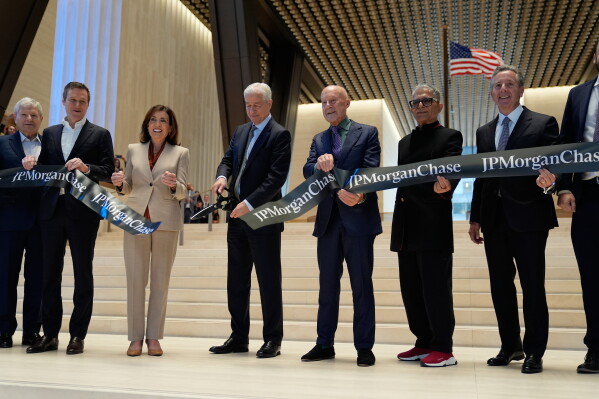
JPMorgan found its tech IPO pipeline before the roadshow
JPMorgan startup banking is feeding tech fee share as early credit lines turn into IPO and M&A mandates, even as Goldman keeps marquee listings.

JPMorgan Chase led global tech investment banking in the first quarter, taking 16.7 per cent of sector fees, while technology supplied 22 per cent of the bank’s $3.2 billion in investment-banking fee revenue, Reuters reported, citing LSEG data. The ranking matters because it shows a decade-old startup-banking push starting to pay off in underwriting and advisory revenue.
The cleanest example is Pattern. JPMorgan began working with the e-commerce software group when revenue was about $100 million and stayed with it as sales rose to $2.5 billion. Reuters said the relationship ran through a $225 million Series B, a $150 million revolver and, later, a $300 million IPO. That sequence is the point: plenty of tech mandates now start years before an IPO beauty parade, with deposits, payments, treasury work and credit.
Founders and venture investors who still judge banks against the old Silicon Valley Bank model see the story less triumphantly. CNBC’s reporting on JPMorgan’s startup push showed that JPMorgan picked up clients during the 2023 panic, but also stressed what those clients still want: fast onboarding, founder-specific service and fewer signs of big-bank bureaucracy. Winning the long game is not the same as feeling like the default choice on day one.
For that reason, JPMorgan’s rise reads as more than a one-quarter fee story. The race for the next wave of tech IPOs and M&A mandates now begins before a company has a prospectus, and sometimes before it has a seasoned finance team. A bank that controls the operating account and the first revolver is better placed to win the offering memo later. JPMorgan is betting on platform breadth. Goldman Sachs is still betting that prestige and trophy mandates carry the most weight at the top of the table.
In Reuters’ report, Andrew Kresse, JPMorgan’s co-head of innovation economy, described the approach as a lifecycle platform rather than a one-product sale.
“We’re building something different, a platform that serves founders from their early days and throughout their entire life cycle.”
— Andrew Kresse, JPMorgan co-head of innovation economy
The pipeline starts before the IPO
Within JPMorgan, startup banking is no sidecar. Reuters said the bank’s innovation-economy unit now covers 11,000 startups globally, employs 550 bankers and has added 200 hires since 2023. Those are not vanity numbers. They point to a coverage machine built to reach companies before venture investors start thinking seriously about IPO timing or strategic exits.

Timing also helped. CNBC reported in March that when Silicon Valley Bank collapsed, JPMorgan saw a rush of demand from founders looking for a safer balance sheet and a bank that still understood venture-backed cash flow. Doug Petno, the co-head of JPMorgan’s commercial and investment bank, described the surge in blunt terms.
“We had three years’ worth of incoming clients in a weekend.”
— Doug Petno, JPMorgan co-head of commercial and investment bank
His quote answers one of the central questions in the research bundle: how much of the mandate pipeline begins with ordinary banking products rather than a formal capital-markets pitch. Quite a lot, on this showing. Pattern is the clearest case, but Reuters also cited companies such as DoorDash and Voyager as signs the model can repeat. The commercial bank is feeding deals to investment banking by design.
The backdrop helps too. CNBC’s report on Mercury’s latest funding round showed that fintech can still attract fresh capital and higher valuations, with Mercury reaching $5.2 billion, up 49 per cent in 14 months. For JPMorgan, that matters less as a single-client story than as a sign that the pool of venture-backed companies worth courting early is expanding again.
Fee share is not the same as bragging rights
Analytically, JPMorgan’s case gets stronger and narrower at the same time. Stronger, because 16.7 per cent of global tech investment-banking fees is hard to dismiss as a lucky quarter when it sits beside a broad client funnel and a measurable revenue contribution from technology. Narrower, because fee share speaks to mix and breadth, not necessarily to victory in every prestige contest.
The distinction matters. Reuters reported that JPMorgan led overall tech investment banking, while Goldman kept the top M&A slot. Recent IPO positioning points to the same split at the very top of the market. CNBC reported that SpaceX chose Goldman Sachs for the lead-left position on its expected listing, and the Financial Times argued that the mandate gave Goldman the bragging rights even if rival banks remained on the cover. JPMorgan may be winning the broader fee pool while Goldman still wins the dinner-table conversation.

Fragile is not the right word for JPMorgan’s position. The results clarify the franchise it has built. Its pitch is not that every mega-listing will choose JPMorgan first. It is that enough companies will start with JPMorgan, borrow from JPMorgan, hedge with JPMorgan and eventually raise capital with JPMorgan for the aggregate economics to turn in its favour, even when the IPO of the month goes elsewhere. On that reading, technology banking leadership looks less like a beauty contest and more like distribution economics.
In Reuters’ account, John Simmons, JPMorgan’s co-head of global banking, made the platform argument directly.
“We are uniquely positioned to support a company from its early days into becoming one of the most significant tech companies in the ecosystem.”
— John Simmons, JPMorgan co-head of global banking
The builder-optimist view in the research bundle helps explain why that claim lands now. If companies such as SpaceX and OpenAI really do reopen the upper end of the tech IPO market, the next few years will favour banks that can offer a continuous platform from seed-stage cash management to public-market execution. A single win on one prospectus will still matter, but the banks with the deeper client base may capture more of the surrounding revenue.
Founders still want speed
Execution is the main risk to JPMorgan’s model. Founders do not choose a bank because it has the best speech about lifecycle coverage. They choose a bank because opening the account is fast, treasury tools work, venture-debt terms are competitive and the coverage team does not disappear between rounds. CNBC’s March reporting captured that skepticism directly: JPMorgan could benefit from Silicon Valley Bank’s collapse and still fail to feel startup-native if its processes stay too slow.
That is why the skeptic view belongs near the centre of the story, not in a token caveat at the end. The more JPMorgan turns startup banking into a funnel for investment-banking fees, the more pressure it takes on to prove the funnel is not leaky. Specialist fintechs and venture-focused providers still compete on user experience, and founders who need only a payments stack or a clean operating account can switch long before an IPO comes into view. The platform strategy works only if the bank keeps enough of those clients long enough for the deferred revenue to arrive.
Still, the balance of evidence tilts toward JPMorgan. It built the coverage model before the fee pool fully reopened, used the Silicon Valley Bank shock to accelerate client acquisition and now has enough scale to show the strategy in league-table results rather than only in internal talking points. The analyst question, whether 16.7 per cent marks a structural shift or a cyclical rebound, remains open. Pattern suggests it is more than a rebound. A company does not move from Series B to revolver to IPO with the same bank because of one good quarter.
Wall Street’s tech banking race has moved upstream. The prize is no longer just the IPO mandate announced at the roadshow. It is the operating relationship built years before anyone files. Goldman may still control some of the most visible mandates, and that prestige will keep mattering. JPMorgan, though, has found something more repeatable: a way to turn early-stage banking into later-stage fee share. In a market waiting for the next generation of giant tech listings, that may prove the more valuable position.
Naomi Voss
Banks and deals reporter covering bank earnings, fintech, M&A and IPOs. Reports from New York.