Nvidia concedes China AI chip market to $12B rival Huawei
Nvidia's Jensen Huang says the company has 'largely conceded' China's AI chip market to Huawei, marking a permanent reset of the AI silicon landscape.
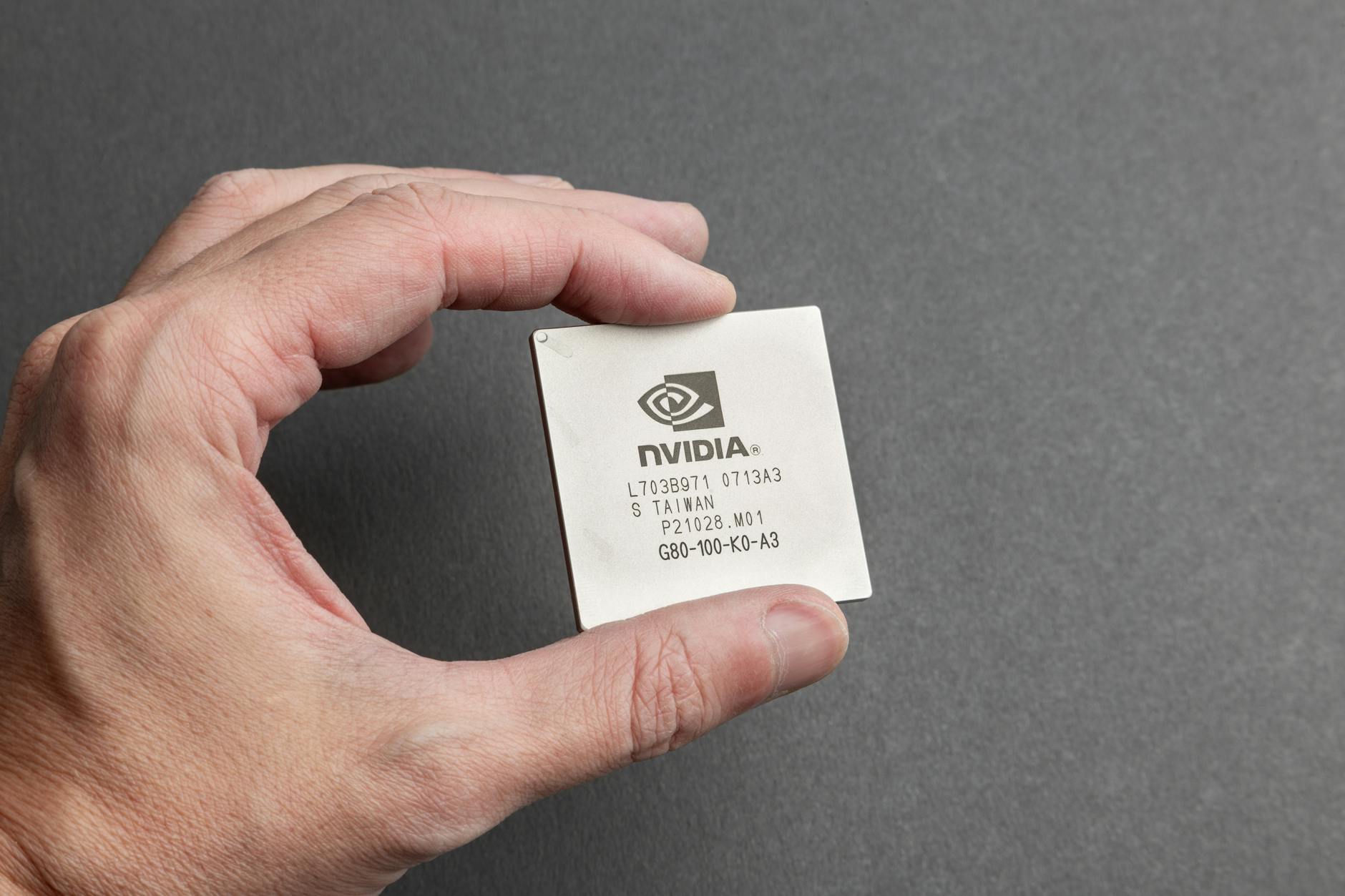
Nvidia chief Jensen Huang said the company has “largely conceded” China’s advanced AI chip market to Huawei, the most explicit acknowledgment to date that US export controls have permanently reshaped the competitive dynamics for artificial intelligence silicon. The admission came hours after Nvidia reported first-quarter revenue of $81.62 billion, up 85 per cent from a year earlier — a staggering number that makes the China concession, not the earnings beat, the story.
Huawei is very, very strong. They had a record year, they’ll likely, very likely, have an extraordinary year coming up, and their local network of chip companies are doing quite well, because we’ve evacuated that market.
— Jensen Huang, Nvidia CEO
The nut of Huang’s message to investors was unambiguous: stop modelling a China recovery. “I don’t have any expectation, which is the reason why we put all of our guidance, all of our numbers, all the expectations that I’ve set with all of our analysts and investors to invest nothing, to expect nothing,” Huang told CNBC. Nvidia’s $78 billion annual revenue guidance assumes zero revenue from advanced chip sales to China, effectively writing off a market that two years ago accounted for an estimated 20 per cent of the company’s data-centre revenue.
China’s AI chip sector was previously dominated by Nvidia, which sold products worth roughly $17 billion — mostly H20 chips designed to comply with US export restrictions — into the market before Washington tightened the rules. Those sales have now gone to zero. And the door, Huang’s comments suggest, is not swinging back open.
What the shift means for Nvidia’s revenue geography
The permanent loss of the Chinese market reshapes Nvidia’s revenue map in ways the stock market’s single-minded focus on hyperscaler demand has obscured. China once represented somewhere between $3.5 billion and $4 billion in annual data-centre revenue for Nvidia — not the largest geography, but the fastest-growing until the controls hit. That revenue has been replaced not by a rival geography but by a rival supplier.
Nvidia’s answer has been to double down on the American cloud giants. Microsoft, Amazon, Google, and Meta now account for an overwhelming share of Nvidia’s data-centre sales, a concentration that makes the company’s revenue stream structurally narrower even as the absolute numbers soar. The $80 billion share buyback programme announced alongside the Q1 results signals confidence, but it also reflects a company whose growth runway has been shortened by geopolitics rather than technology.

Industry analysts frame the question in starker terms: if Chinese domestic chipmakers reach 80 per cent self-sufficiency by 2027, as Bernstein projected earlier this year, is there any path back for Nvidia beyond a residual 15 per cent share of the local market? Huang’s own language — “conceded,” “evacuated,” “expect nothing” — answers that question before any Wall Street model does.
CUDA’s moat, reversed
The hardware story gets the attention, but the software dimension matters more over the long arc. Nvidia’s CUDA platform has been the moat that locked developers in for nearly two decades: write once on CUDA, run everywhere on Nvidia. That lock-in is now unwinding inside China.
Chinese AI developers who once built on CUDA are migrating to Huawei’s CANN platform and the MindSpore framework at a pace that surprised even industry observers. The switching cost equation has inverted: the cost of staying on a platform with no legal hardware to run it now exceeds the cost of retooling for a domestic alternative. Beam AI Insights noted in a recent analysis that Huawei’s software stack has improved enough that Chinese hyperscalers are now building inference pipelines entirely around domestic hardware — a structural shift that makes return migration to Nvidia, even if export controls were lifted tomorrow, economically irrational.
That is the deeper concession Huang is making. He is not just ceding silicon sales; he is ceding a generation of AI developers.
The paradox at the heart of export controls
Here the policy story takes an uncomfortable turn. The stated purpose of US chip export controls — maintained across both the Biden and Trump administrations — was to slow China’s AI progress and prevent the country from developing competitive frontier models. By that metric, the results are paradoxical at best.
We’ve really largely conceded that market to them.
— Jensen Huang
In the two years since the controls tightened, China has built a domestic AI chip market worth an estimated $21 billion, according to Ars Technica. Huawei is on track to control 60 per cent of it by year-end, with projected AI chip revenue of $12 billion in 2026 — a 60 per cent jump from $7.5 billion in 2025. DeepSeek’s V4 model, one of the most capable open-source large language models, runs on Huawei silicon. The export controls did not prevent a Chinese AI competitor from emerging. They gave it a captive market.
A Council on Foreign Relations analysis cited by the New York Times argues that Huawei still lags Nvidia by roughly two generations in raw training performance — a meaningful gap for frontier-model builders. But the argument loses force when most production AI workloads are inference, not training, and Huawei’s Ascend 950PR chip, delivering up to two petaflops of FP4 performance with 128 gigabytes of high-bandwidth memory, is competitive in the segment where the money is.
Double-door lockout
If there was ever a narrow path for Nvidia back into China — a negotiated relaxation of export rules, perhaps tied to a Trump-Xi trade deal — it has been closed from both sides. In December 2025, the Trump administration approved H200 chip sales to ten Chinese companies. Not one of those approvals has resulted in a purchase. Beijing, in what Trump himself later described as a sovereign refusal, has declined to sanction the imports.
The signal grew louder during the May 2026 Trump-Xi summit, when China banned Nvidia’s RTX 5090D V2 — a gaming GPU with AI-derivative applications — while Huang was in Beijing for the talks. The timing was deliberate: a message that even consumer-adjacent Nvidia silicon faces a regulatory wall, and that Washington’s approval means nothing without Beijing’s. The Guardian reported after the summit that chip sanctions were discussed but yielded no agreement, leaving Nvidia in the same position it was in before Huang’s plane touched down.
For the regulators watching from Washington and Brussels, the lesson is discomfiting. A policy designed to preserve American AI primacy by starving China of advanced silicon has instead created the conditions for a fully independent Chinese AI hardware-software stack — one whose developers are now building for a market that will not need Nvidia again.

Huawei’s ascendance, in numbers
Huawei’s AI chip business has moved from speculative to structural inside two years. The Ascend 950PR, built on a domestically sourced 7-nanometre process, delivers competitive inference throughput against Nvidia’s export-restricted H200, and the company’s Atlas 950 SuperPoD strategy — pooling thousands of chips at rack scale — targets the same high-density data-centre configuration that hyperscalers use for production AI.
Chinese technology companies have turned to domestic chips en masse as Nvidia has remained shut out of the market. The shift is no longer stopgap; it is the procurement baseline. Government directives instruct state-backed enterprises and cloud providers to buy domestic, and the price-performance of the latest Ascend generation has reduced the premium that once made compliance costly.
The bifurcated market
Huang’s candour does not signal Nvidia weakness — the $81.62 billion quarter and the $80 billion buyback make that clear. But it does signal a permanent bifurcation of the AI chip market into two non-overlapping stacks: a US-led one built around Nvidia, TSMC, and CUDA, and a China-led one built around Huawei, SMIC, and CANN. The first will supply American and allied hyperscalers. The second will supply China’s cloud and AI industry. Neither will cross the other’s border at scale again.
For Nvidia shareholders, the China concession is already priced into the stock — Huang made sure of that by embedding zero expectations into forward guidance. For the broader semiconductor industry, the concession is a data point in a larger story: that the decoupling the export controls set out to slow has, if anything, accelerated.
Sloane Carrington
Markets columnist. Analytical pieces and deep-dives on monetary policy, capital flows and corporate strategy. Reports from New York.