ASML sales forecast raised again as AI chip demand holds
ASML sales forecast rose to €43bn-€45bn after Q2 beat estimates, suggesting AI chip spending is still flowing into the toolmakers at the top of the chain.
ASML raised its full-year sales forecast to €43bn-€45bn on Wednesday after second-quarter net sales of €9.3bn beat the €8.8bn LSEG consensus and net profit of €2.9bn topped expectations for €2.6bn, giving investors a fresh read-through on the question hanging over semiconductor stocks this month: is AI infrastructure spending still accelerating, or is the buildout starting to pause?
For now, the answer from the top of the semiconductor equipment stack is that customers are still spending. The second guidance lift this year, alongside a 54 per cent to 56 per cent gross-margin outlook, arrived days after Taiwan Semiconductor Manufacturing Co. Ltd. reported a 68 per cent jump in June revenue. Taken together, those numbers suggest the AI trade is still moving through foundries, memory suppliers and back into the bottleneck companies that decide how quickly new capacity can actually be built.
But the same figures look different through the analyst and policy lenses. Morningstar senior equity analyst Javier Correonero has argued that ASML still trades on a monopoly-style multiple of roughly 50 times forward earnings, while management also expects China to account for about 20 per cent of 2026 sales. That leaves the stock exposed to two questions at once: whether the cycle can stay hot enough to justify the valuation, and whether export controls can stay stable enough to let the revenue show up.
As Christophe Fouquet’s remarks to CNBC made clear, management is treating the first issue as an execution problem rather than a demand problem.
Order intake remained “extremely strong” in the first half of the year.
— Christophe Fouquet, ASML chief executive, via CNBC
What matters here is that ASML is not a downstream beneficiary of AI enthusiasm in the way a server assembler or cloud name might be. It is the company selling the lithography systems without which the rest of the chain cannot move. If its order book is still strengthening after two guidance increases in one year, the cleaner interpretation is that the capex cycle remains supply-constrained, not demand-starved.
The order book still looks full
The more revealing part of ASML’s update was not the headline beat on the quarter. It was the evidence that customers are still committing money across the product portfolio even after a year in which almost every AI-linked name has faced questions about how long the spending can last.

In June, MIT Technology Review described ASML’s most advanced systems as machines that can cost as much as $400m. That scale matters for how this cycle should be read. A foundry does not place those orders on a whim, and it does not expand the surrounding cleanroom, service and installation pipeline unless it sees a long enough demand runway to earn the return. When management says stronger bookings are “translating into customer commitments across our product portfolio”, that is a more useful signal than another round of debate over whether the next AI server rack ships a month early or late.
Downstream data still points in the same direction. TSMC’s June revenue release partly answers the question raised by the user-affected perspective in the fact bundle: are foundries and memory makers still spending hard enough to keep ASML’s backlog full? A 68 per cent year-on-year jump does not prove that every part of the AI buildout is equally healthy, but it does show that the most important leading-edge foundry in the system is still operating in an environment of extraordinary demand. SK Hynix’s coming US market debut points to the same appetite around high-bandwidth memory, another critical part of the AI stack.
Here the piece’s first contrast becomes useful. From Fouquet’s insider vantage point, the challenge is whether ASML can keep output rising fast enough. From the buyer’s vantage point, the question is whether there are enough tools, installed quickly enough, to stop lithography from becoming the factor that delays the next wave of capacity. Those are different concerns, but right now they point to the same conclusion: the buildout still looks constrained by supply at the top of the chain, not by a sudden collapse in customer willingness to spend.
Fast Company’s reporting on Nvidia’s China slowdown is a reminder that the cycle is not uniform everywhere. Still, that geographic divergence does not undercut the broader read-through from ASML’s quarter. It sharpens it. If Nvidia can face regional pressure and yet the toolmaker above the foundries can still raise guidance again, the centre of gravity in AI capex remains stubbornly firm.
As Correonero put it in CNBC’s earnings report:
ASML is doing a great job in bringing that capacity in.
— Javier Correonero, Morningstar senior equity analyst, via CNBC
A harder analyst question is what happens once it has brought enough of that capacity in. ASML’s quarter answers the demand question for 2026 more convincingly than it answers the valuation question for 2027.
Capacity is the constraint
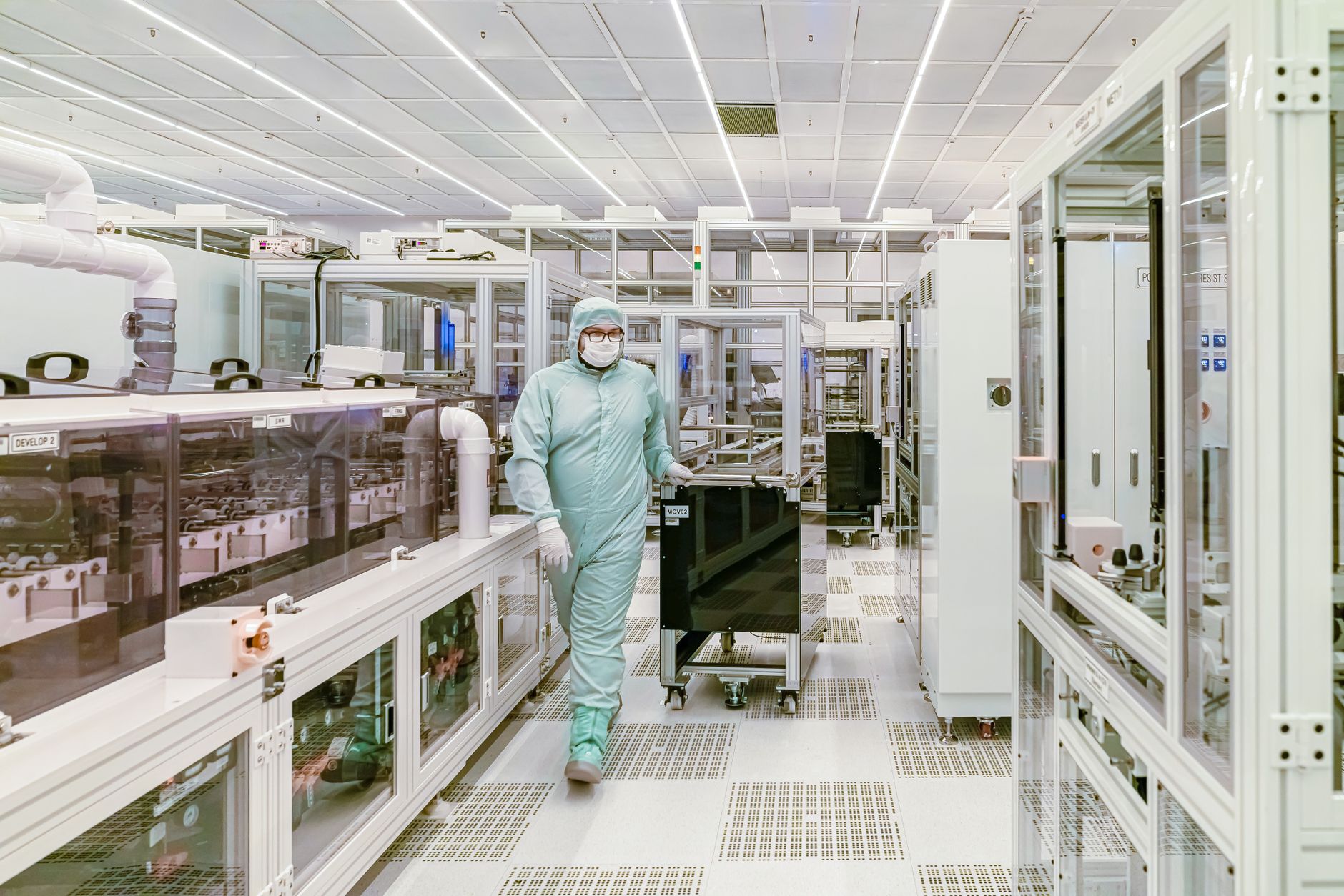
If the market wants to know where the next limit sits, ASML told it plainly. Fouquet said the company aims to lift low-NA EUV and DUV immersion capacity by 30 per cent in 2026. That is less a victory lap than an admission that the next leg of growth depends on ASML’s own ability to manufacture, ship, install and service more of the industry’s most complex tools.

Capacity discipline matters because investors often talk about the AI trade as if demand were the only variable. Demand has been loud for months. The more useful question now is how much of that demand can be converted into wafers, memory modules and accelerator shipments on schedule. ASML sits at the point where that optimism has to become hard industrial output. Every extra tool requires optics, precision engineering, cleanroom preparation, installation crews and customer sites ready to absorb the system. In other words, the company is not just selling exposure to AI. It is selling the speed at which the industry can industrialise its own enthusiasm.
It also explains why ASML’s guidance carries more weight than a generic tech-earnings beat. MarketWatch’s pre-earnings preview had already framed the company as the first major checkpoint for this results season, precisely because investors wanted to know whether the spending wave around Nvidia, foundries and advanced memory was beginning to normalise. Instead, ASML delivered another data point that the tool bottleneck is still binding.
There is a history to that bottleneck. Related coverage this summer has kept circling the same fact: ASML occupies a position in the semiconductor chain that is closer to monopoly infrastructure than to ordinary equipment supply. MarketWatch argued in June that the AI infrastructure buildout had made ASML’s extreme ultraviolet systems uniquely scarce. The useful takeaway is not the hero worship around the stock. It is the operating reality underneath it. Monopoly-like status does not remove execution risk; it concentrates it. If ASML slips on output, the rest of the chain feels it.
It also partly answers one of the insider perspective’s questions as well. How quickly can low-NA EUV and DUV capacity rise without creating new bottlenecks in shipments and cleanroom space? Not fast enough to make the constraint disappear, and fast enough, so far, to keep customers committed. That is why the quarter reads as an extension of the boom rather than a late-cycle flourish.
China is still the risk
The cleanest bullish read on ASML is also the one most vulnerable to policy shock. The company still expects about 20 per cent of 2026 sales to come from China, which means the regulator-policy perspective cannot be treated as background noise. If AI demand remains strong, Washington has more reason, not less, to worry about where the most important tools and adjacent DUV systems are being sold.
Policy risk has already become more concrete. TechCrunch reported in June that US officials believed ASML’s top chip tool might be in China, a claim the company disputed. Days later, Bloomberg reported that the Netherlands was lobbying Washington not to widen export controls targeting ASML sales. Investors do not need to assume an immediate revenue hit to see the asymmetry. Another modest guidance increase would probably be treated as business as usual. A new export restriction would force a repricing exercise.
China also complicates the valuation debate. A stock priced like irreplaceable infrastructure can justify that rating only if its market access remains wide enough to let the order book convert into sales. If 2026 is the year ASML proves AI capex is still real, it may also be the year the market is forced to separate demand durability from revenue certainty.
So this quarter matters beyond one Dutch company’s earnings. ASML’s second guidance lift says the AI chip capex boom is still intact at the top of the semiconductor chain. It does not say the boom is risk-free. The company is still a proxy for two very different ideas at once: that customers are spending aggressively to expand AI capacity, and that the geopolitical regime around advanced chipmaking can still change faster than valuations can absorb.
For now, the first idea is winning. The most useful way to read ASML’s quarter is not as a routine tech earnings beat, and not as a verdict on every AI stock. It is a hard capex signal from the one company whose machines tell the industry whether enthusiasm is turning into real capacity. On that measure, the buildout still has room to run.
Sloane Carrington
Markets columnist. Analytical pieces and deep-dives on monetary policy, capital flows and corporate strategy. Reports from New York.