Apple sues OpenAI over trade secrets, raising IPO risk
Apple sues OpenAI over trade secrets, turning a talent fight into a concrete governance and litigation risk for its hardware push and any IPO path.
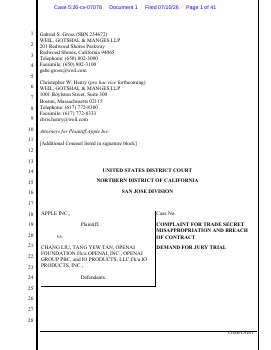
Apple sued OpenAI and two former Apple executives in California federal court on Thursday, saying the ChatGPT maker used hiring for its hardware team to obtain confidential Apple information. The case puts a recruiting fight into a federal docket and gives investors a defined litigation risk to watch at one of Silicon Valley’s largest private companies.
In a complaint filed in the Northern District of California, Apple said OpenAI’s conduct went beyond ordinary poaching and reflected an organized effort to move trade secrets into a competing hardware program. The shift for OpenAI’s partners and would-be investors is venue. The allegations are now before a court, where discovery requests, injunction fights and a public factual record could follow if the case advances.
The company tied the case to OpenAI’s hardware buildout and named Tang Yew Tan, OpenAI’s chief hardware officer, as a central figure. Tan spent 24 years at Apple before joining OpenAI, according to the filing. Apple also named Chang Liu, a former employee who spent eight years at the iPhone maker and left in January 2026 for OpenAI. The complaint says Apple wrote to OpenAI in February with concerns before filing suit, suggesting it first tried to press the issue privately.
That timeline gives the case a different cast from a standard employee-mobility dispute. Apple is asking the court to examine how OpenAI built a sensitive hardware unit, not just the conduct of two former staffers. Hardware programs hold design files, product road maps and supply-chain knowledge in a way most hiring disputes do not.
Put another way, the complaint frames the matter as a controls question as much as a trade-secret claim.
Apple’s language is blunt for a dispute between two companies that recently still had room for commercial partnership. In the court papers, the company said the suit was needed to stop former employees from using its confidential information for OpenAI’s benefit.
“This case is about Apple’s former employees stealing Apple’s trade secrets for the benefit of OpenAI. Apple brings this suit to put a stop to it.”
Apple complaint, filed in federal court in California
Apple also says the alleged scheme may be only “the tip of the iceberg”, language that points toward a broader discovery fight if the case survives early motions. Trade-secret suits usually turn on whether the plaintiff can identify specific confidential material, show how it moved and trace who inside the defendant organization knew about it. By presenting the dispute as institutional, Apple is asking for scrutiny of management oversight as well as employee conduct.
OpenAI rejected that framing. An OpenAI spokesperson told MarketWatch the company had no interest in other companies’ proprietary information, pushing back on Apple’s claim that the conduct reflected a wider internal culture problem.
“We have no interest in other companies’ trade secrets.”
OpenAI spokesperson, MarketWatch
Why it matters for OpenAI
The timing is awkward for OpenAI. The allegations touch one of the areas where the company has been trying to widen its story beyond software models and enterprise subscriptions. A trade-secret case tied to hardware hiring does not only create legal expense. It can complicate recruiting, raise diligence questions for suppliers and investors, and force management to defend the controls it uses when hiring senior executives from a secrecy-heavy rival.
That market frame matters more than the bare existence of a complaint. Any eventual route to public markets would bring closer scrutiny of material litigation and internal controls, even if OpenAI is not near an IPO filing. A live Apple suit adds a concrete item for counterparties to diligence: whether a court lets the case proceed far enough to expose emails, hiring discussions and product-planning records.
Relations between Apple and OpenAI had already worsened, a shift the Financial Times cast as a broader collapse in ties between the companies. Against that backdrop, the filing is more than a narrow employment fight. It moves the dispute from competitive tension into open legal conflict as OpenAI pushes further into devices and other physical products.
The next steps are procedural but important. Apple will have to back its language with detailed evidence, while OpenAI is likely to argue that the case is a conventional employee-mobility dispute. If the complaint survives early motions and reaches meaningful discovery, it could become a recurring governance overhang for OpenAI’s hardware ambitions. Before any ruling, Apple has turned a rumored talent-poaching fight into a documented legal conflict that investors, partners and rivals can track.
Tomás Iglesias
Financial regulation and legal affairs. SEC, CFTC, FCA, market-structure and enforcement. Reports from Washington.