OpenAI lawsuit puts AI IPO valuations on notice in 2026
OpenAI lawsuit risk now sits inside AI IPO pricing as Florida's case adds liability, governance and timing pressure to the listing race.
Florida’s lawsuit against OpenAI and Sam Altman has widened from a consumer-safety case into a valuation problem for the AI listing pipeline, forcing investors to price litigation and governance risk alongside revenue growth.
Alone, the case does not mean an OpenAI IPO is derailed. It means the first state-led complaint against the company now sits in the same risk file as compute spending, founder control, model pricing and the sudden arrival of Anthropic in the public-market queue.
Uthmeier’s regulator-policy view is blunt. Florida Attorney General James Uthmeier says the state is not merely asking whether ChatGPT gave bad answers. It is asking whether OpenAI marketed a product while ignoring safety warnings, including risks to minors, according to the Florida attorney general’s release.
For capital-markets desks, the read is colder. Underwriters do not need a plaintiff to win before they reprice uncertainty. They only need a plausible path to recurring legal costs, broader disclosure, tighter controls or a delay in getting a prospectus past risk committees.
When safety becomes underwriting
An 83-page complaint is a long-form risk factor in lawsuit clothing. CNBC reported that Florida sued OpenAI and Altman while seeking to hold the chief executive personally liable for alleged harms tied to ChatGPT and the company’s safety practices. The New York Times described Florida as the first state to sue OpenAI over chatbot-safety concerns, while Bloomberg reported that the case includes claims around children under 13 and parental consent.
Allegations remain allegations. OpenAI will contest them. Public-market diligence, however, does not wait for a final judgment before changing the questions it asks a private company trying to sell shares.
“OpenAI and Altman ignored internal and external safety warnings, put children at great risk.”
— James Uthmeier, Florida attorney general
More important for IPO lawyers, the quote reads like a template. If other attorneys general copy Florida’s framing, AI safety becomes less like a Washington policy argument and more like tobacco, opioids or social-media youth-safety litigation: a state-by-state process that can add legal reserves, executive depositions, consent-decree negotiations and product redesign to the cost of doing business.

For an ordinary mature company, that might be annoying rather than existential. For OpenAI, which has been discussed in IPO coverage at a valuation of more than $850 billion, it becomes part of the multiple. Private investors can mark a story up on scarcity. Public investors get to demand a discount for every risk they can name.
The governance discount
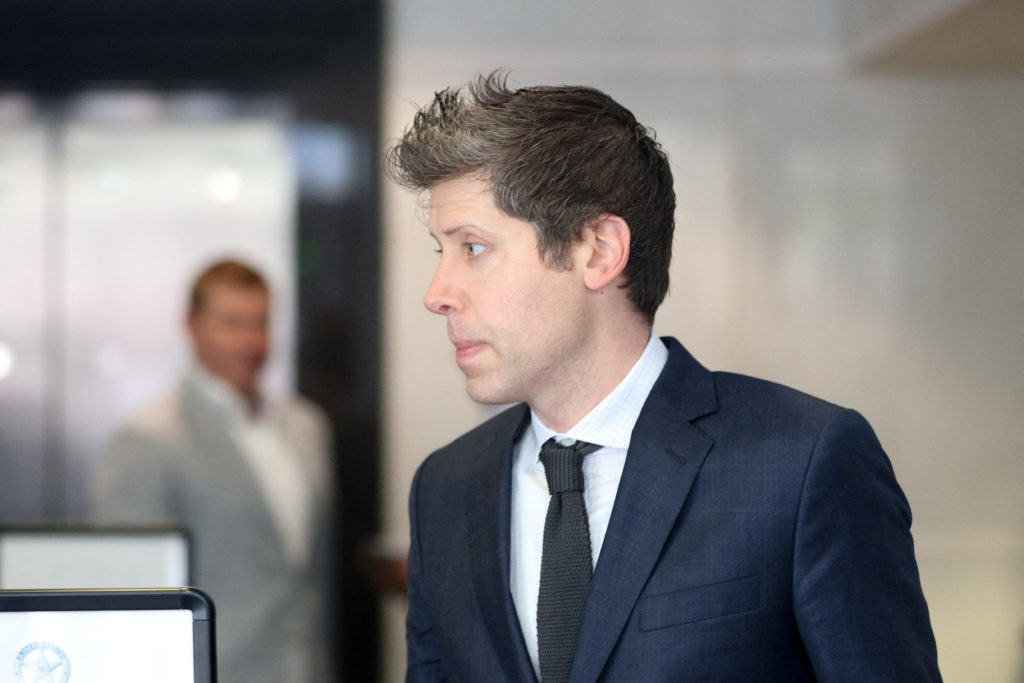
Personal liability is the sharper financial signal. CNBC’s coverage said Florida is seeking to hold Altman personally liable for alleged harms. That lands on top of an already live debate about whether the dominant AI companies are built with governance structures public investors can understand, police and, if necessary, challenge.
In OpenAI’s case, the chief executive is not a normal pre-IPO manager. Altman is the face of the category, the strategist behind the company’s commercial turn and the person investors associate with both its ambition and its control questions. Semafor’s earlier coverage of Altman’s scrutiny around OpenAI’s IPO plans captured the same issue from a different lawsuit: when founder governance is already under a microscope, every new legal process becomes part of the diligence trail.
Skeptics do not have to argue the lawsuit changes OpenAI’s technology, customer demand or revenue curve. It may still change directors-and-officers insurance pricing, board oversight language, indemnification arrangements and the way institutional investors model headline risk. Those costs rarely appear in a splashy valuation deck. They appear later, in underwriting emails, IPO roadshow questions and a longer risk-factor section.
OpenAI’s own response, as reported by Bloomberg, tries to push the issue back toward product responsibility rather than market readiness.
“AI is a new and powerful technology, and we believe minors need significant protection.”
— OpenAI, statement reported by Bloomberg
As policy language, that answer is reasonable. As IPO language, it is also an admission that the category is still negotiating its operating perimeter. Public shareholders tend to tolerate regulatory gray areas when growth is accelerating and liability is bounded. They are less forgiving when the gray area is tied to children, personal data and chief-executive accountability.
The valuation stack was already full
Timing is awkward. Anthropic has filed confidentially for a US IPO, Business Insider reported, with coverage putting its private valuation at $965 billion. OpenAI is racing toward its own public-market moment, and CNBC’s analysis has already warned that cheaper AI models could undermine the pricing power behind frontier-lab valuations.

From an analyst’s seat, legal risk is not hitting a clean balance sheet. It is joining a crowded stack. Investors are already asking whether hyperscale AI spending will earn enough return, whether model access becomes a commodity, and whether data-center commitments create operating leverage or a fixed-cost trap.
Altman has acknowledged the spending concern directly. Business Insider quoted him saying that questions about AI capital expenditure are fair, a useful signal because it shows the criticism has moved from outsider skepticism to boardroom-level debate.
“So I think this is the most fair criticism right now of AI.”
— Sam Altman, speaking about AI spending concerns
Compute economics make the legal overhang easier to dismiss in isolation and harder to ignore in combination. Wired reported that Anthropic agreed to pay SpaceX $1.25 billion a month through May 2029 for access to cloud computing infrastructure. If public investors are already being asked to accept multi-year compute obligations, they will also ask whether legal and compliance obligations are predictable or open-ended.
IPO timing is where the lawsuit’s presence becomes more important than its merits. A private company can absorb noisy litigation in private meetings. A company preparing to list has to disclose, explain and repeatedly update it. The more unresolved the case looks, the more it becomes a roadshow question rather than a footnote.
How investors will price it
One channel is timing. A state lawsuit gives lawyers and bankers a reason to slow down a filing, add disclosure or wait for an early procedural ruling. That does not mean a September-style IPO window, as some OpenAI coverage has suggested, is impossible. It means the window now has more dependencies.
Another channel is the operating model. If Florida’s claims push OpenAI toward stricter age controls, more prominent disclosures or narrower product defaults for minors, the company may still benefit over time. Better controls can protect a category leader. In the near term, though, they complicate the growth story because the best IPO narratives are simple: expanding demand, rising margins, clear governance and controllable risk.
Comparables bring the risk back to the broader AI cohort. Anthropic, OpenAI and adjacent AI infrastructure names are not identical. Investors still build a basket when a new sector comes to market. If OpenAI carries a visible state-litigation overhang, rivals may pitch themselves as cleaner governance stories. If the claims spread, the whole cohort may be priced with a larger liability reserve.
None of this requires a bearish call on AI. Public markets have rewarded companies with regulatory risk when the revenue base was durable and the rules became clearer. The issue is that the AI labs are trying to command mature-software valuations before their liability regime has matured.
Not just courtroom drama
Litigation may not be the last case investors read before the AI IPO race settles. MarketWatch has already framed OpenAI’s next legal battle as one against states that claim its models are dangerous, and Axios’ local coverage shows how quickly the Florida action became a political and consumer-safety story beyond Silicon Valley.
Optimists still have a case. OpenAI has demand, brand power, enterprise momentum and a founder whose ability to raise capital has repeatedly outrun doubts about structure. If the company can show safety controls are improving and legal exposure is contained, investors may treat Florida as an expensive but manageable cost of scale.
A cleaner version of the IPO story was available before the Florida suit: compute, pricing power, enterprise adoption and model differentiation. Now the pitch also has to include liability, governance and whether a state attorney general can force a private AI leader to behave like a regulated consumer platform before it becomes a public company.
That is a different pitch. It is still investable. It is just harder to price at any valuation that assumes the legal regime will stay soft.
Sloane Carrington
Markets columnist. Analytical pieces and deep-dives on monetary policy, capital flows and corporate strategy. Reports from New York.