Real wages shrink in developed countries as inflation rises
Real wages shrink in developed countries as oil-driven inflation outpaces pay, squeezing households and leaving central banks less room to cut.
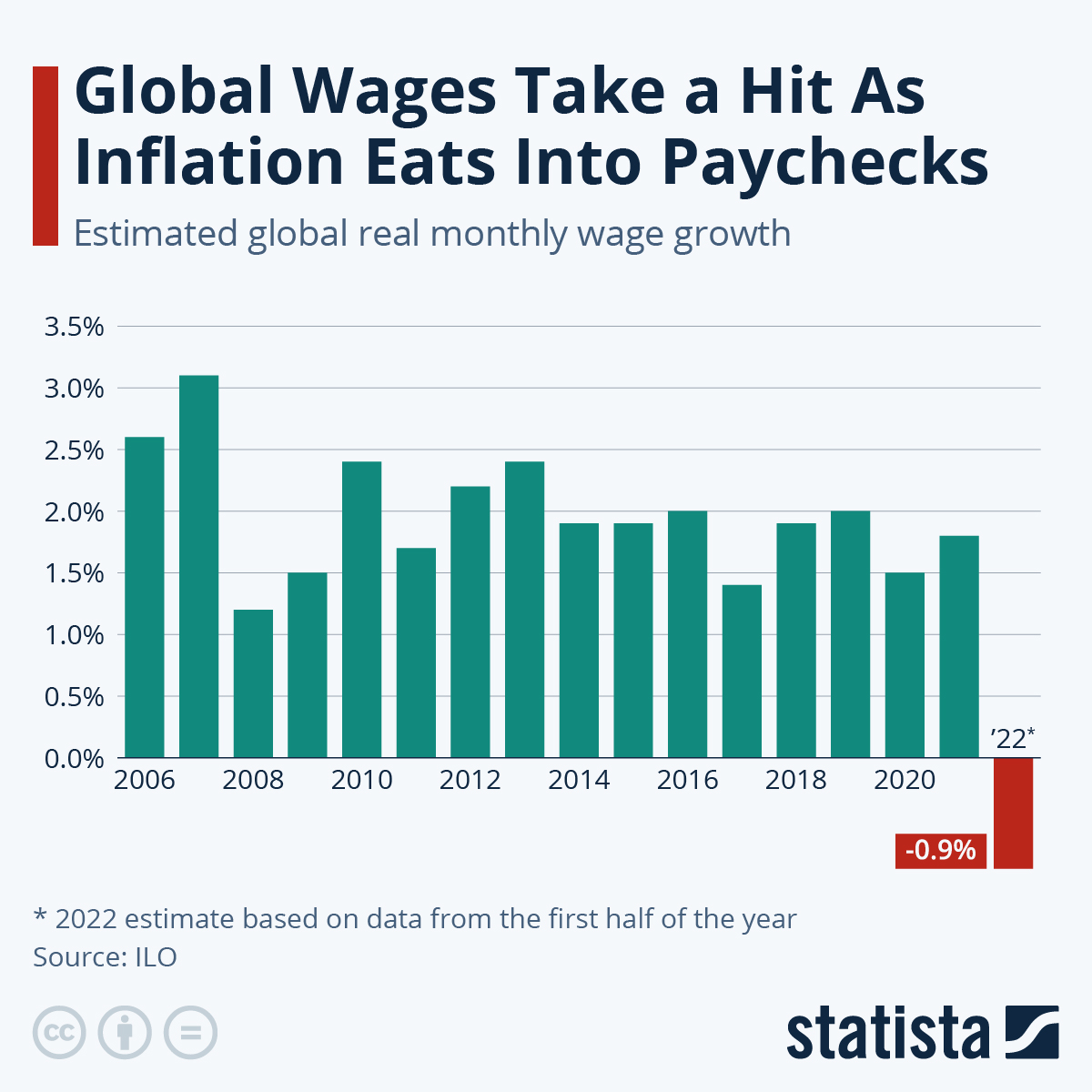
Real wages are starting to shrink across developed economies as the Strait of Hormuz shock pushes fuel and food prices up faster than pay packets, turning what began as an energy-market jolt into a direct hit to household purchasing power. The Financial Times reported on Tuesday that the gap has opened in the US, UK and elsewhere just as policymakers were still counting on a slow repair in living standards.
Before oil and shipping costs rose again, the post-pandemic wage recovery was already incomplete. In its latest wage bulletin, the OECD said real wages were still below early-2021 levels in half its member economies, while labour group TUAC said 19 of 37 countries had yet to claw back lost purchasing power. Nominal pay is still increasing in many places. The problem is arithmetic: if prices climb faster, workers are still poorer in real terms.
For markets, the implication is awkward rather than explosive. A supply shock that lifts headline inflation does not automatically recreate the wage-price spiral investors spent 2022 trying to price, but it does narrow central banks’ room to ease. Bond traders can price fewer rate cuts. Households, meanwhile, feel the squeeze first at the pump, on utility bills and at the supermarket checkout. That is why the latest wage story matters beyond labour statistics.
The recovery was already slowing
One warning in the OECD’s report stands out. Wages have not collapsed. The recovery was decelerating before the Hormuz crisis fed another round of imported inflation into developed economies. Workers are therefore exposed to even a modest acceleration in prices, because there is less catch-up left in the pipeline.

Real wages continue to rise in virtually all OECD countries. However, the pace of their recovery is slowing.
— OECD, The real wage recovery is slowing down
Read closely, though, and the line is less comforting than it first appears. If the rebound in real pay is already slowing while energy prices move higher again, the direction of travel can change quickly. The OECD explicitly said real wages remain below early-2021 levels in half of member countries. TUAC’s reading of the same data, published here, is starker: 19 of 37 OECD economies are still underwater.
Nominal pay can still look healthy in a labour-market headline. A 4 per cent raise feels like progress in isolation. It does not feel like progress if petrol, freight, food and household essentials rise faster. That is the trap policymakers are confronting. It is also why wage data that once looked compatible with disinflation now look fragile.
Britain offers one clear example. Reuters reported that regular wage growth slowed to 3.8 per cent in the three months to January, the weakest pace in five years. April inflation later eased to 2.8 per cent, according to Guardian Business reporting, helped by softer household energy bills, but that relief was already being treated as temporary because fuel and food costs were moving the other way. In the US, Reuters reported a 0.6 per cent increase in consumer prices in April, which pushed annual inflation to its biggest gain in three years as price rises broadened out.
Continental Europe does not look insulated either. Bloomberg reported that euro-zone wage growth had already slowed before the latest war-driven inflation pulse hit, which matters because it suggests households entered this phase with less buffer than nominal pay settlements implied. Put differently, the new squeeze is landing on top of an incomplete old one.
Central banks inherit the shock
Policymakers face the awkward part here. Rates can crush demand. They cannot pump more oil through Hormuz, lower marine insurance premiums or reverse a fuel-led jump in headline prices. Yet if headline inflation re-accelerates while real wages turn negative, officials face a narrower path between tolerating another income shock and tightening into softer growth.

Hence the significance of the UK’s April inflation print, which looked cooler on the surface but did not settle the policy debate. Introducing the data in the Guardian’s live coverage, NIESR associate economist Charlotte O’Leary warned that the slowdown might prove fleeting.
Today’s slowdown in April inflation to 2.8% may look promising, but this is likely as low as it gets for some time.
— Charlotte O’Leary, NIESR, via Guardian Business
Traders hear “higher inflation” and often jump straight to “more hikes”. That is too neat. ING’s developed markets economist James Smith, quoted in the same Guardian coverage, said markets were overestimating the Bank of England’s willingness to tighten further. That caution matters. A supply shock can keep inflation uncomfortable while simultaneously weakening real consumption, a combination that leaves central banks looking constrained rather than powerful.
Across jurisdictions, the bind is similar even if the policy settings are not. The Federal Reserve can point to a still-resilient labour market, but Reuters’ US inflation report showed price pressure broadening again. The European Central Bank may be farther along the easing path, yet Bloomberg’s reporting suggests wage momentum was already cooling before the latest price impulse. The Bank of England has weaker wage growth and a fresh fuel problem at the same time. Different economies, same bind: less confidence that disinflation will do the central bank’s work for it.
Bond markets are where that bind becomes visible. If workers cannot rebuild purchasing power, household demand becomes more fragile. If energy keeps inflation elevated, policymakers cannot relax quickly either. The result is the kind of higher-for-longer backdrop that keeps front-end yields firm, mortgage and corporate borrowing costs sticky, and every growth forecast provisional. Not a recession call, at least not from the data in hand. A reminder, though, that the disinflation narrative is no longer moving in a straight line.
What households and markets should watch
Households will test the story before economists do. The next question is not whether nominal wages still look positive on a chart. In many countries, they do. The question is whether upcoming pay settlements can beat an inflation pulse driven by imported energy and the second-round effects that follow it through freight, food and services. If they cannot, the real-income squeeze broadens from a statistical concern into a consumption problem.
In other words, this story carries more weight than a single inflation print. Real wages are the transmission channel between geopolitics and the domestic economy. Higher crude prices matter to traders immediately. They matter to households once the weekly shop, the commute and the utility bill absorb a larger share of income. When that happens across several major economies at once, the effect is cumulative: weaker spending power, noisier inflation expectations and less scope for policymakers to offer relief.
Politically, the timing is awkward as well. After the inflation shock of 2022 and 2023, governments and central banks could argue that real incomes would heal gradually as headline price growth cooled. The OECD’s latest assessment suggests that healing process was already losing momentum. The Hormuz shock risks interrupting it before large parts of the developed world got back to where they started.
For scramnews readers, the market read-through is simple. Watch fuel, food and wage settlements together, not in isolation. A stronger wage print on its own is not necessarily inflationary if it merely restores lost purchasing power. A softer inflation print on its own is not necessarily reassuring if it arrives just before another energy leg higher. What matters is the spread between pay and prices. Right now, across much of the developed world, that spread is closing the wrong way.
Helena Brandt
Macro reporter covering the Federal Reserve, ECB, inflation prints and jobs data. Reports from Washington.