Korean volatility is becoming Asia's clearest foreign-flow warning
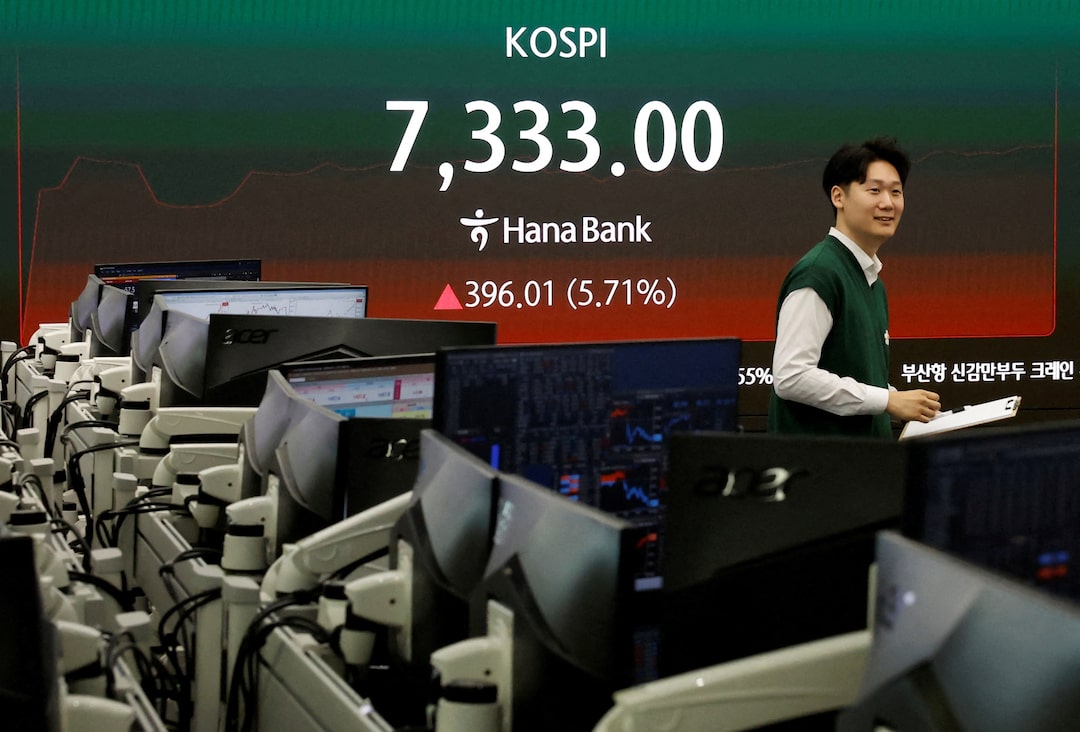
Foreign investors sold $13.2 billion of Korean equities in a week, pushing Kospi volatility toward crisis-era territory and turning Seoul into a live test of how quickly Asia risk appetite can crack.
South Korea’s stock-market volatility moved close to record highs on Monday after foreign investors dumped $13.2 billion of local equities last week. The retreat is turning Seoul into one of the clearest gauges of how quickly global capital can recoil when geopolitics, oil prices and growth fears start feeding one another.
That is why the move matters beyond one national benchmark. Korea is a deep, liquid market that foreign funds can enter and exit quickly. The country’s equity tape often compresses several macro arguments into a single trade: confidence in Asian exports, appetite for semiconductor exposure, and tolerance for emerging-market risk when headlines out of Washington or the Middle East darken. A market that can drop 4 per cent intraday, as CNBC reported, is no longer sending a local message alone.
The sharp selling does not yet prove panic. Daishin Securities analyst Kwon Soon-ho argued that “The recent large-scale net selling therefore reflects profit-taking and rebalancing demand rather than an active position reduction.” That distinction matters. If Kwon is right, the outflow is a violent rotation after gains rather than a wholesale verdict on Korea’s corporate sector. Even so, scale changes the read. Seoul Economic Daily reported foreigners sold roughly 20 trillion won over four sessions. Selling that large can overwhelm calmer explanations in the short run because the tape itself starts resetting risk models.
International investors tend to watch Korea earlier than some peers when stress builds, and for reasons that go beyond index weightings. The market is open, institutionally owned and heavily exposed to the global manufacturing cycle. Shifts in foreign positioning can look like a referendum on Asia’s export complex before they show up in Tokyo or Taipei. That does not make Korea destiny for the region. It does make it a fast barometer — and one that is easy to misread if you look only at local headlines. Foreign selling in Korea hits the benchmark quickly because overseas funds are a major price-setting bloc in the market’s largest stocks. When that cohort turns defensive, the benchmark can reprice faster than the underlying macro story. Volatility is carrying information even before a final judgement on growth or earnings arrives.
Why Korea is leading the signal
The broader flow backdrop was already deteriorating before this week’s volatility spike. A Bank of Korea official said the stock market had seen outflows for four straight months as investors monitored geopolitical risk in the Middle East. The same Yonhap report cited central-bank data showing net foreign sales of $2.13 billion in April. The $13.2 billion weekly exodus landed on top of an existing withdrawal pattern — it did not come from nowhere.
That history makes the move more useful as a risk indicator. Earlier in the year, Reuters reported that South Korea was the hardest-hit market in a broader February foreign selloff across Asia, with $13.67 billion of outflows. A single bad session can be shrugged off as positioning noise. Recurring episodes of Korea leading regional outflows suggest global funds are using the market as a liquid place to cut Asia exposure when the macro picture gets harder to price.
For global allocators, that makes Korea closer to a live stress test than a lagging indicator. If overseas money is selling Seoul first, it may be because Korea offers liquidity, sector beta and a transparent route to hedge Asia exposure. But those same qualities mean the move can overshoot. Speed is useful because it delivers signal early. Speed can also magnify fear before fundamentals catch up.
The current episode becomes sharper when you stack the pressures hitting at once. Oil-sensitive inflation worries have returned as Middle East tensions stay in play. US rate expectations remain a constraint on global equity multiples. China’s uneven demand picture still hangs over exporters across the region. None of those forces is unique to Korea. But Korea is one of the first places they become visible in price action, partly because foreigners can move fast and partly because the market’s biggest names are tied to global growth.
Seo Sang-young of Mirae Asset Securities linked the widening decline directly to the shift in US after-hours futures after President Donald Trump said he would no longer tolerate Iran. His point was about transmission, not grand macro theory. When a geopolitical headline hits, Korean equities can absorb the shock almost immediately because they sit at the intersection of regional risk sentiment and global portfolio flows. That makes Seoul worth watching even for investors with no direct Korea position.
What would turn stress into spillover
The case for contagion needs more evidence than the Korean tape alone. The biggest risk in reading too much into this move is that a market dominated by foreign trading and concentrated sector exposures can exaggerate the first leg of a global de-risking cycle. If the selling is still largely profit-taking and rebalancing, as Kwon suggested, then Korea is flashing yellow, not red. Warning signal, not crisis call.
Broader investors should watch next for whether the selling starts to migrate from Korea as an early outlet to Asia as a confirmed theme. A second sign would be persistent weakness in US and regional futures after geopolitical headlines, not just one-session jolts. A third would be foreign withdrawals continuing even when oil stabilises and event risk cools. Without those confirmations, Korea is showing how thin the margin for risk-taking has become — an important signal, but not yet a region-wide one.
Local stabilisers matter too. If domestic institutions or retail buyers start absorbing part of the foreign selling and intraday swings narrow, the market looks less like a contagion channel and more like an exhausted rotation. If volatility keeps rising even as bargain buyers step in, the pressure is broader than positioning.
Markets do not need a full-blown crisis to change character. They only need enough investors to decide that liquidity is more valuable than conviction. Korea’s recent swings suggest that threshold is lower than it looked a few weeks ago. For global funds, Seoul is not broken. It is simply the first place where the pressure becomes visible.
Sloane Carrington
Markets columnist. Analytical pieces and deep-dives on monetary policy, capital flows and corporate strategy. Reports from New York.