CAMELS overhaul resets how US bank exams score risk
CAMELS overhaul would recast US bank exam ratings around material financial risk, narrowing when management flaws alone can drag a score lower.
U.S. banking agencies have proposed the biggest rewrite of the CAMELS bank-rating system in nearly 30 years. The plan would change how examiners weigh capital, liquidity and management weaknesses so supervisory grades track material financial risk more closely.
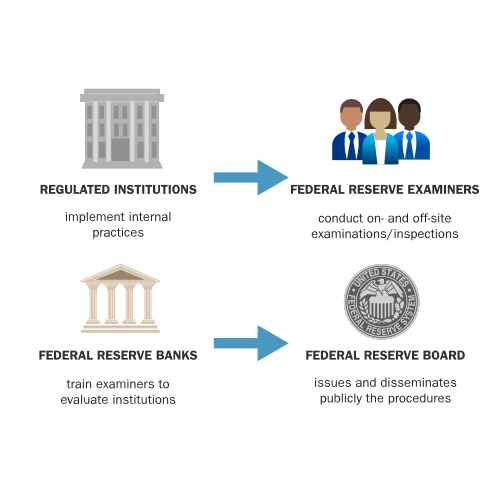
The Office of the Comptroller of the Currency said the interagency package would revise the Uniform Financial Institutions Rating System, which underpins federal bank exam grades. Even when banks never disclose their CAMELS marks, those scores shape supervisory escalation, merger and expansion requests, and the tone of later exams.
The proposal, published in the Federal Register, would strip the Management component of its long-standing special status inside the composite CAMELS score. A weak management finding would no longer carry extra weight by default when supervisors set an institution’s overall rating.
The agencies would also narrow the circumstances in which a management score of 3 or worse pulls down the broader rating. In most cases, that step would require evidence of material financial risk rather than process criticism alone, though unreliable reporting, failures to safeguard assets or significant legal noncompliance could still justify lower marks.
The distinction matters. It draws a firmer line between documentation lapses and weaknesses that threaten capital, earnings or funding, which is where banks and their boards often clash with supervisors over whether criticism is procedural or financially consequential.
Regulators say the goal is not to go easier on banks. It is to make the grades easier to read and defend. The OCC said the rewrite would “focus ratings on material financial risk and improve the transparency of ratings,” while the proposal recasts capital, liquidity, earnings and market-risk factors around more concrete measures such as cash-flow forecasting, funding costs and net interest income.
For supervisors, the narrower trigger could also make it easier to explain why one bank receives a harsher composite score than a peer with similar paperwork issues but weaker funding or earnings capacity.
Greg Baer, president and chief executive of the Bank Policy Institute, said the change would bring ratings closer to banks’ actual condition.
“Today’s proposal would align banks’ ratings more closely with their financial condition and focus bank supervision on material financial risks.”
— Greg Baer, president and CEO of Bank Policy Institute
Why it matters for supervision
Since the regional-bank turmoil reopened questions about supervisory follow-through, bank oversight has faced pressure to show earlier escalation and a cleaner record of why an exam score moved. That helps explain why regulators are now trying to make the ratings framework easier to interpret and defend.
The Consumer Finance Monitor analysis called the package a philosophical shift in supervision. The Federal Register text also removes references to reputational risk that banks have long argued were too subjective.
For executives and directors, the reset could change how they prepare for exams. A framework that ties downgrades more explicitly to material financial risk may push firms to spend less time rebutting qualitative criticism and more time documenting cash-flow resilience, funding concentrations, earnings durability and the reliability of internal reporting. It could also give boards a firmer basis for deciding whether a poor component score is a warning or evidence of immediate balance-sheet strain.
The proposal is open for public comment for 90 days, with comments due by Aug. 17. Any final rule would still need agreement across the FFIEC agencies, so banks are unlikely to see the new scorecard in the field soon. The direction of travel is clearer, though: regulators are testing a rating system that says less about process for its own sake and more about the financial risks that can weaken a bank.
Tomás Iglesias
Financial regulation and legal affairs. SEC, CFTC, FCA, market-structure and enforcement. Reports from Washington.