Lisa Cook says Fed sees tokenization as market-plumbing risk
Lisa Cook's digital-assets speech showed the Fed is weighing tokenization and stablecoins through settlement, liquidity and financial-stability risks.
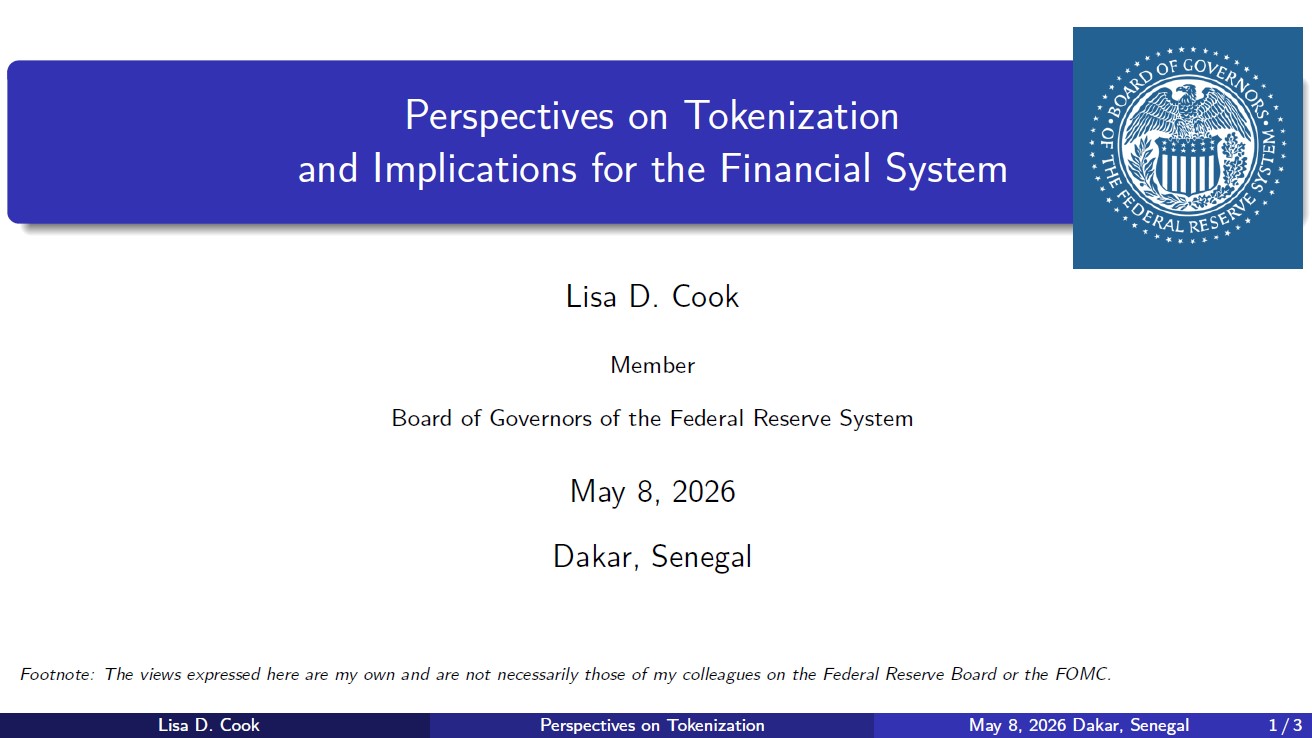
Federal Reserve Governor Lisa Cook used remarks on digital assets and the financial system to lay out how the Fed is approaching tokenization and stablecoins: as questions of settlement, liquidity and financial stability rather than crypto marketing or price action.
That matters as Washington continues to sort out stablecoin and market-structure rules while private firms push tokenized Treasuries and other assets deeper into payments and collateral flows. Cook said tokenized assets in the U.S. have more than doubled over the past year to about $25 billion, still small beside traditional markets but large enough for policymakers to ask where new frictions or vulnerabilities could emerge.
Cook also made clear she does not see tokenization as a niche experiment. She said the technology could improve recordkeeping, speed settlement and widen access to capital markets, especially in places where cross-border payments remain slow and expensive. The C-SPAN event record showed the remarks were delivered in a public-policy setting, and Cook built the case in that order: possible efficiencies first, then the effect those efficiencies could have on the wider system.
In the text of the speech, Cook said, “I do not see tokenization as replacing traditional market infrastructure.” For banks, brokers and stablecoin issuers, that was the clearest policy signal in the address. Cook’s point was that on-chain rails may develop alongside existing intermediaries, not outside them, so concerns about operational resilience, settlement finality and liquidity backstops do not disappear when an asset moves onto a tokenized rail.
Where the Fed sees risk
Across post-trade markets, many transactions still take an extra business day to settle, which helps explain why tokenization appeals to firms that want cash and collateral to move faster. But the same compression of time can create new pressure points. Cook warned in the speech that 24/7 trading and settlement could speed runs on issuers rather than merely make markets more convenient.
She put the broader concern directly, saying: “It is important to consider how risk dynamics could change or manifest in new or different ways with this technology.” That shifts the debate away from the familiar Washington argument over whether digital assets should be embraced or constrained as a category. In Cook’s framing, the more pressing question is what happens when tokenized claims start to touch payments, funding and investor access at scale.
Cook also avoided presenting the technology as a simple threat. She said tokenization could bring clear benefits in emerging economies, including faster cross-border payments and better access to capital markets. A broader Stanford policy forum on digital assets and AI showed how quickly those questions have moved into mainstream policy debate, but Cook kept her own remarks fixed on market function: where settlement becomes easier, where access expands and where a new fragility could appear.
For market participants, the main takeaway was not a crypto-specific turn by the Fed. It was that senior policymakers are beginning to describe stablecoins, tokenized assets and related market plumbing in the same terms they already use for liquidity, settlement and financial stability. That change in vocabulary suggests the next phase of oversight may be shaped less by crypto branding and more by how quickly stress can travel once these instruments sit closer to the financial core.
Tomás Iglesias
Financial regulation and legal affairs. SEC, CFTC, FCA, market-structure and enforcement. Reports from Washington.